Learn to surf in Morocco
What actually happens in a beginner week, and how far you get by the end of it
Almost everyone stands up on the first day. What separates a good week from a frustrating one is what happens after that.
Why this coast forgives beginners
Three things make the stretch north of Agadir unusually kind to people who have never surfed.
The swell arrives tired. Storms in the North Atlantic generate energy thousands of kilometres away. By the time it reaches this latitude it has organised into long, evenly spaced lines rather than choppy wind swell — which means waves that break in the same place, in the same way, repeatedly. Predictability is the entire game when you are learning.
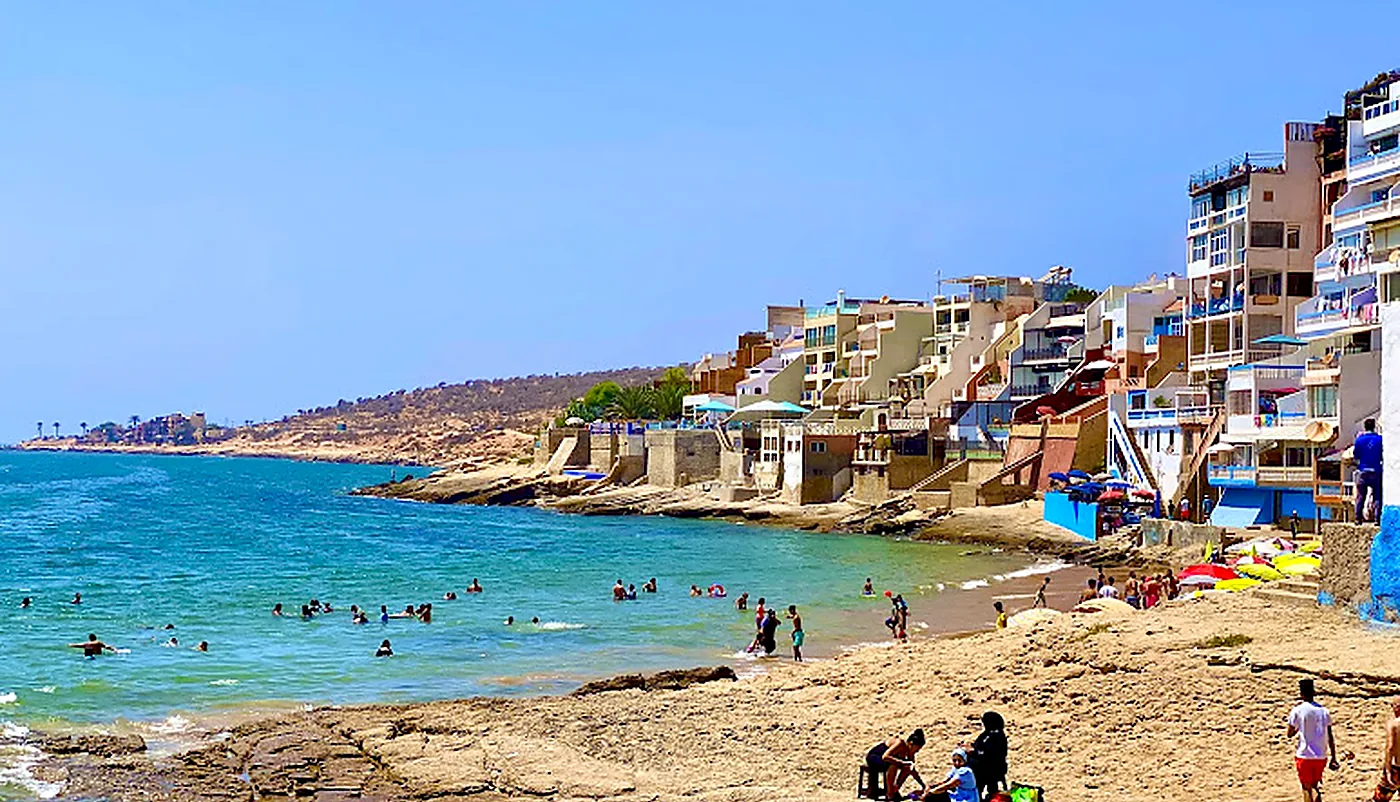
The coast faces the right way. The shoreline runs roughly northeast to southwest, so headlands bend incoming northwest swell into long right-hand points. Between those points sit sandy bays that take the leftover energy — smaller, softer, sand-bottomed. Those bays are where you spend your first three days.
Mornings are usually clean. Land cools overnight, so wind at dawn is typically light or offshore and builds onshore through the afternoon. That is why lessons start early, and why your second session of the day is sometimes bumpier than the first.
How fast you will actually progress
Measured in sessions rather than days, because a "day" at one camp is two coached hours and at another it is twenty minutes of instruction and a lot of standing around.
| Sessions | What you will be doing | What is holding you back |
|---|---|---|
| 1–2 | Standing in whitewater, some of the time, on a big soft board | Pop-up timing, and looking down at your feet |
| 3–4 | Standing on most attempts, riding straight to the beach | Fear of burying the nose, which makes you lean back |
| 5–7 | Turning the board to travel along the wave instead of at the beach | Paddling fitness. Your shoulders are the bottleneck now |
| 8–12 | Catching unbroken waves with a push, then without one | Wave reading — knowing which one breaks where |
| 12–20 | Picking your own waves in a small green lineup | Positioning, and an honest need for a smaller board |
A one-week camp with two sessions a day puts most people in the 8–12 band. That is genuinely surfing, on small waves, with a soft board — a realistic target rather than a sales figure.
A day in the water
The shape of it, hour by hour
| Time | What happens |
|---|---|
| 08:00 | Breakfast on the terrace. The forecast gets checked and the day's spot announced |
| 09:30 | Load boards, drive 10–40 minutes to whichever break suits the tide |
| 10:00 | Theory on the sand, then 90 minutes coached in the water |
| 12:30 | Lunch on the beach or back at the accommodation |
| 14:30 | Second session — free surfing, with your instructor watching rather than teaching |
| 17:00 | Back for a shower, tea, and the afternoon activity |
| 19:30 | Dinner together, then video analysis of the morning's footage |
What speeds you up, and what slows you down
Speeds you up
- Video review. Ten minutes watching yourself corrects what ten sessions of being told will not
- A dry-land pop-up routine. Five minutes each morning. Unglamorous, extremely effective
- Staying on the soft board. Volume catches waves, and catching waves is practice
- Surfing tired legs, not tired shoulders. Rest the paddling muscles, not the standing ones
Slows you down
- Groups above eight. You are being supervised rather than taught
- The same bay every day. You learn one wave instead of learning to surf
- Surfing exhausted. By day four one good session beats two bad ones
- Going out too deep too soon. The whitewater zone is where the repetitions are
Before you arrive
Four things worth knowing
You need to be comfortable in water
Not a strong swimmer — you are on a floating board with a leash and an instructor a few metres away. But being out of your depth should not panic you. Say so honestly when you book, and a good camp places you accordingly.
The sea is colder than you expect
Around 17–19 °C for most of the year. A cold current and seasonal upwelling keep it well below what the latitude suggests. Most camps include a wetsuit and carry a range of thicknesses — the listing says which.
Sunburn is the most common injury
By a wide margin, followed by reef cuts. Bring SPF 50, zinc for your face and a rash vest. Reapply after every session, not just at the start of the day.
Your arms will ache by day three
Paddling uses muscles that most people never use. It passes. Yoga, the hammam and a rest afternoon exist precisely for this, and they are not an indulgence.
Keep reading
Everything else worth knowing before you book
Surf Spots
Individual guides to sixteen surf spots between Agadir and Tamri, by level, swell direction, tide and crowd. Which suit beginners and which to avoid.
Best time to go
Swell, water temperature, wetsuit thickness and desert heat for all twelve months, so you can pick the right week for surf and Sahara.
Surf & Sahara
Four days learning to surf on the Atlantic, then over the High Atlas to sleep in the dunes of Erg Chebbi. 7 days, departs every Monday, from €615.