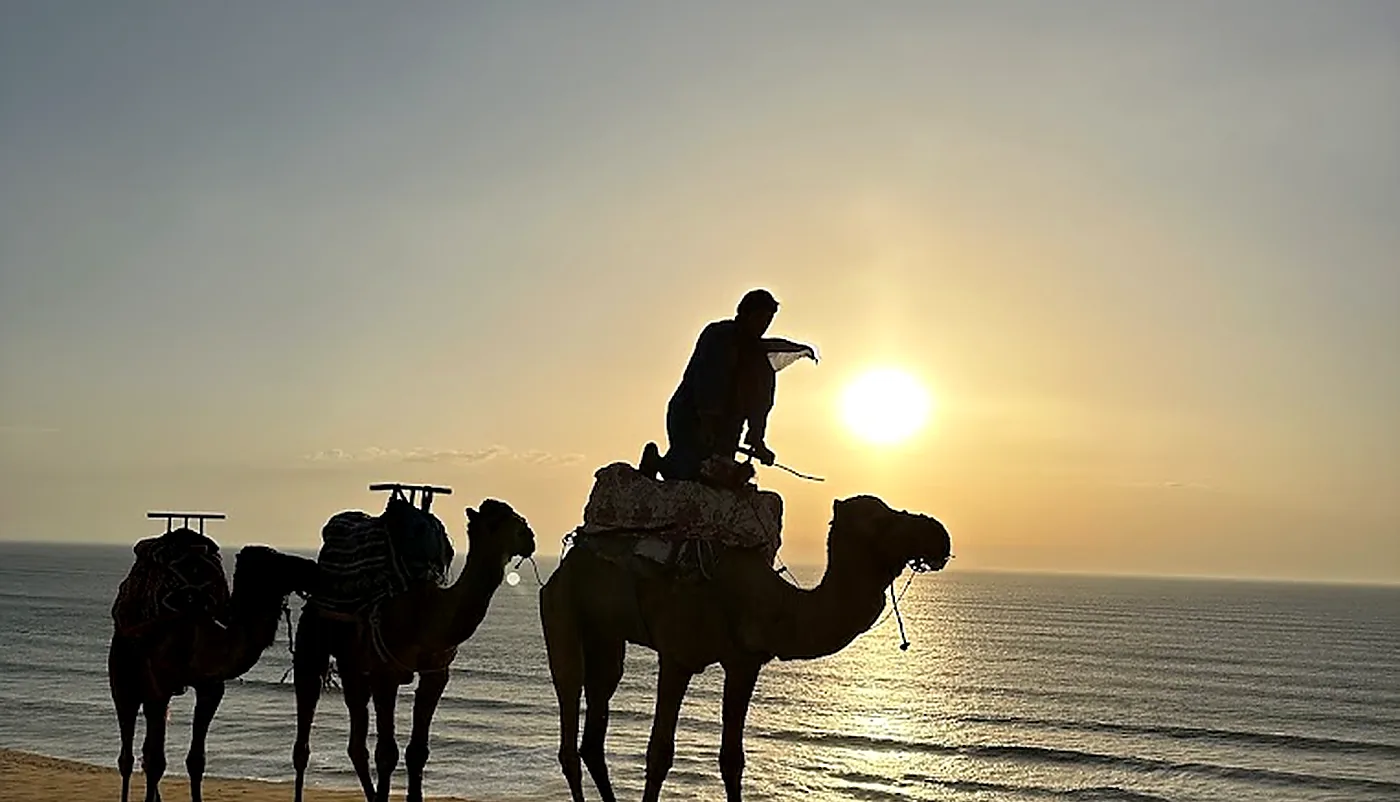
Surf & Sahara: seven days from the Atlantic to Erg Chebbi
Four days learning to surf, three days crossing Morocco to sleep in the dunes
Morocco is one of the few countries where a complete beginner can take a surf lesson on Monday morning and sleep on a Saharan dune by Saturday night.
The catch is distance. The learner-friendly waves sit on the Atlantic coast near Agadir; the tall dunes sit around 700 kilometres inland, on the far side of a 2,260 metre mountain pass. Trips that try to do both in four or five days end up spending more time in a vehicle than in the water or on the sand.
This week is built the other way round. Four unbroken days on the coast — long enough to actually learn something rather than just get wet — then the inland leg split across three days with real stops, finishing in Marrakech so you never drive the same road twice.
The route, in numbers
Compare trips on hours in a vehicle, not on the number of places listed
| Segment | Distance | Driving | What it's like |
|---|---|---|---|
| Agadir airport → the coast | ~35 km | 25–40 min | Coast road. The only short transfer of the week |
| Coast → Tizi n'Tichka pass | ~300 km | 4 hrs | Argan country, then switchbacks to 2,260 m |
| Pass → Aït Ben Haddou | ~60 km | 1 hr | Down into red rock and kasbah country |
| Ouarzazate → Tinghir | ~170 km | 2.5 hrs | The Valley of a Thousand Kasbahs |
| Tinghir → Erg Chebbi | ~260 km | 3.5 hrs | Emptying hammada, then suddenly dunes |
| Erg Chebbi → Marrakech | ~560 km | 8 hrs | The return leg, with mountain stops |
Around 17 hours of driving in total, spread across three days. This is published because most operators do not, and it is the honest way to compare one desert trip against another.
Day by day
Monday to Sunday · coast to Marrakech
Arrival and first stance
Afternoon check-in at the house in Taghazout, board and wetsuit sizing, and a walk through the village past the points. A surf-skate session teaches your feet the position on dry land. Dinner on the terrace, then surf theory.
First waves and the souk
Two sessions with lunch between — the first coached, the second free surfing. Afternoon at the traditional market in Agadir. Video analysis after dinner.
Yoga and Paradise Valley
Morning yoga, one surf session, then inland to a palm gorge with natural pools carved into pink rock. Swimming and cliff jumping when the water level allows.
Day trip to Imsouane
North along the coast to the house on the bay at Imsouane, for one of the longest, slowest right-handers in Morocco. Surf, lunch at the fishing harbour, back in the late afternoon.
Over the Atlas
Early start across the Tizi n'Tichka pass at 2,260 m. Aït Ben Haddou, the fortified earthen village, then Atlas Studios. Night near Ouarzazate.
Into the dunes
The Todra gorges at Tinghir, then east until the horizon turns to sand. Sunset on the erg, sandboarding, Berber dinner, drums and a sky full of stars.
Sunrise, then Marrakech
Up before light for sunrise from the dune crest, breakfast at camp, then the scenic drive back through the mountains. Trip ends in Marrakech late afternoon.
Add surf days
Extra surf days go on the front of the week. The inland leg leaves on a fixed morning, so additions are made before the Monday start rather than after the trip.
What is and is not included
So there are no surprises on arrival
In the price
- Six nights: four at the coastal villa, one in a hotel inland, one in a desert camp
- All meals at the surf camp, plus breakfast and dinner on the road and in the desert
- Coached surf sessions with certified instructors in small groups
- Surfboard, wetsuit and leash for the whole stay
- Daily transfers to whichever spot the conditions favour
- Yoga sessions during the coastal days
- Video analysis of your surfing
- Air-conditioned transport and an English-speaking guide for the inland leg
- Sandboarding, desert dinner and the music evening at camp
- Trip to the Agadir market
Not in the price
- Flights, and airport transfers at either end
- Lunches on the two inland driving days
- Atlas Studios entry ticket
- Quad biking in the dunes
- Camel trek, bookable as an optional extra
- Paradise Valley entry and optional coastal activities
- Hammam and spa treatments
- Travel insurance, which should cover surfing
- Tips for guides, drivers and instructors
Worth knowing
- Accommodation is a shared four-bed room by default; private and double rooms on request
- Desert accommodation is a shared Berber tent unless you upgrade
- Groups are usually eight to fourteen people, most of them travelling solo
- Fly into Agadir and out of Marrakech — an open-jaw ticket saves a transfer and is often cheaper
- Nights in the erg are cold from November to February, so pack a warm layer
- Check the moon phase against your date if the night sky is why you're coming
Departure dates
Every Monday from January 2027
Choose a date and the operator confirms availability and the final price within 24 hours.
January 2027
February 2027
March 2027
April 2027
May 2027
Travelling outside these dates, or want extra surf days first? Send your dates and the week can be built around your flights.
Questions about this trip
How many nights do I need for the Surf and Sahara trip?
Six nights is the usual minimum. Most operators run the inland leg from a fixed departure day, so extra surf days are added before it rather than after — check the listing for the day it leaves.
How far is the Sahara from the surf camp?
About 700 kilometres to the dunes of Erg Chebbi, crossing the High Atlas at the 2,260 metre Tizi n'Tichka pass. Operators normally split it across two days with stops at Ait Ben Haddou and the Todra gorges rather than driving it straight through.
What is the best month for surfing and the desert together?
October, November, March and April. Swell is consistent, desert days sit in the twenties and nights are cool rather than freezing. July and August are best avoided for the desert leg, when daytime temperatures reach 40 to 47 degrees.
What do I sleep in at the desert camp?
A Berber-style tent with a proper bed and heavy blankets, in a camp within the dunes of Erg Chebbi. Shared tents are standard and private tents can be requested. Nights are cold from November to February, so bring a warm layer.
Which airport should I fly into?
Agadir is 25 to 40 minutes from the surf villages. Trips that finish in Marrakech make an open-jaw ticket into Agadir and out of Marrakech usually cheaper than two one-way fares, and it saves a redundant transfer.
Is Wi-Fi available?
At coastal accommodation, generally yes. In the desert expect little or no signal and limited power, so download maps and music before leaving the coast and bring a power bank.
Keep reading
Everything else worth knowing before you book
Best time to go
Swell, water temperature, wetsuit thickness and desert heat for all twelve months, so you can pick the right week for surf and Sahara.
Learn to surf
How fast beginners actually progress, what a surf day involves, choosing an instructor ratio, and why this coast is one of the easiest places to start.
Book now
Questions about a booking or a listing, answered within 24 hours.