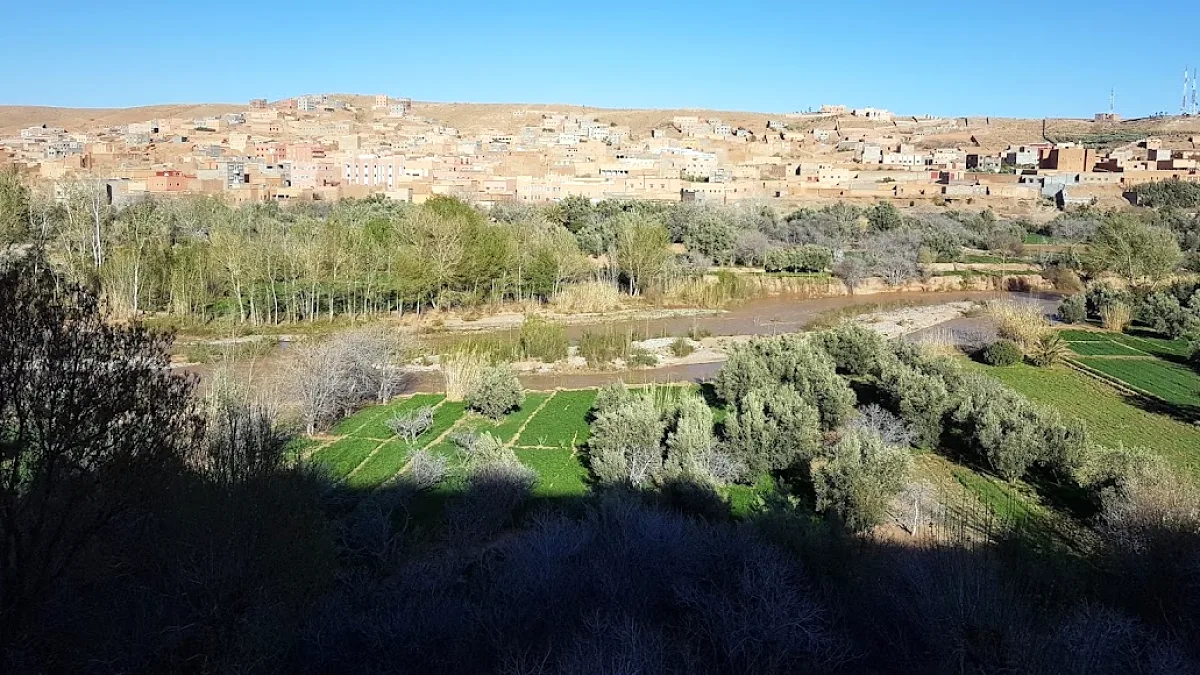
A palm gorge in the foothills of the High Atlas where a river has carved a chain of pools into pink rock. It is what every surf camp on this coast does on a flat day, and it deserves the reputation.
Go on a flat day, not a good one
This is the standard advice from every camp on the coast and it is worth repeating. Paradise Valley will still be there tomorrow; the swell will not. Check the forecast the night before, and if there is anything at all in the water, surf it and move the valley to the flat day. There is always a flat day.
It is close enough for that to work. An hour and a quarter from Taghazout or Tamraght and a little more from Agadir, so it fits an afternoon without costing you a dawn session. Most camps run it as a half day and will swap it around the forecast happily if you ask on arrival rather than on the morning.
The exception is rain in the mountains. A wet week upstream fills the pools and makes the trip worth doing whatever the surf is doing, because the valley is at its best in the days right after it.
Getting there
About an hour inland from the coast, on a winding road through argan groves and small villages. Most camps run it as a half-day trip in the afternoon after a morning surf.
The walk in
From the parking area it is roughly twenty minutes over uneven rock to the good pools. This is the part nobody warns you about: flip-flops make it an unpleasant twenty minutes and trainers make it easy.
The further you walk, the fewer people you share the water with. Most visitors stop at the first pool.
Water levels matter
In spring the pools are full and deep and the cliff jumps are genuinely good. By late summer, after a dry season, levels can drop considerably and some jumps become unsafe or impossible.
Nobody can promise you the high-water version. Ask what conditions have been like recently rather than assuming the photographs are current.
Cliff jumping, sensibly
Only where local guides indicate, only after someone has checked the depth that day, and never as the first person in. Rock levels shift and depths change between seasons. This is the one activity on the coast where showing off has real consequences.
What to bring
Shoes you can walk in, a towel, water, and sun cream. There are small cafés near the entrance serving tagine and juice, but nothing at the far pools.
Beyond the first pools
Most visitors reach the first accessible pool, take a photograph and turn around. Walking a further twenty to forty minutes upstream reaches quieter water, better jumps and, on a weekday out of season, sometimes nobody at all.
The path is not maintained and involves scrambling over boulders and occasionally wading. It is not dangerous in normal conditions and it is not appropriate in flip-flops. Go with somebody who knows the route rather than exploring alone, because the valley narrows and the way back is less obvious than the way in.
The wider region: Imouzzer and the honey villages
Paradise Valley sits on the road to Imouzzer des Ida Outanane, a mountain town known for its waterfalls and for honey. The Ida Outanane region produces thyme, euphorbia and carob honeys, and there is an annual honey festival.
The Imouzzer waterfalls run seasonally and are spectacular after winter rain, which is precisely when the valley pools are also at their best. If you are already driving an hour inland, adding another thirty minutes to see them is worth it in spring.
This upper road is also where the argan groves are densest, and where you are most likely to see goats in trees doing what goats in trees do.
Safety, honestly stated
Flash flooding is the genuine hazard in this valley. Water levels can rise very quickly after rain in the mountains even when it is dry where you are standing. Do not enter the gorge if there has been heavy rain in the last 24 hours or if rain is forecast upstream, and take a local decision seriously if a guide says no.
Cliff jumping causes the injuries. Depths change between seasons as sediment moves. Never jump first, never jump anywhere a guide has not entered that day, and never jump after drinking.
There is no phone signal in most of the gorge and no vehicle access. An ankle broken deep in the valley is a long, slow evacuation.
When to go, and when not to
Best: March to early June, after winter rain has filled the system and before the summer draw-down. Water is high, the jumps are safe and the valley is green.
Acceptable: September to November, cooler and quieter, with lower water.
Avoid: peak weekends in July and August, when it is crowded with domestic visitors and the water is at its lowest. If those are your dates, go early in the morning and walk further than everybody else.
What else is on the same road
The drive to Paradise Valley passes through some of the densest argan forest in Morocco, and the women's cooperatives along it are worth a stop in their own right. They crack, roast and press by hand, and the operation is genuinely interesting rather than a staged demonstration.
Higher up, the Ida Outanane mountains are one of Morocco's honey regions, producing thyme, carob and euphorbia honeys that taste nothing like supermarket honey. Roadside sellers and small shops in Imouzzer stock them.
The Imouzzer waterfalls, another thirty minutes on, run hard after winter rain and are largely dry by late summer. If you are going in March or April, add them.
Combining it with a surf day
The valley pairs naturally with a morning session. Surf at eight, eat, drive inland by midday, swim in the afternoon, back for dinner. It is the standard structure for a reason: the valley is best in the warmest part of the day, which is exactly when the wind ruins the surf.
It also solves the day-four problem. Most beginners hit paddling fatigue on the fourth day, and a half-day in the valley is a better use of it than a bad second session.
Photography and the light
The gorge is deep and narrow, which means it is in shade for much of the day and hard on cameras. Late morning to early afternoon is when light reaches the water and the pools go turquoise.
Bring a dry bag or a waterproof case. The best angles are from in the water, and phones and rock pools have a poor history together.
Drones are restricted in Morocco and the valley is not an exception. Do not plan around one.
Is it worth the trip?
On the right day, yes, comfortably. A palm gorge with deep pools cut into pink rock, an hour from the coast, reached through argan forest — there is nothing else like it within easy reach of the surf villages.
On the wrong day, it is a busy car park, a twenty-minute walk over rock and a shallow pool with thirty people around it. The difference is water level and timing, not luck.
So go in spring if you can, go early in the day, and walk further than everybody else. Those three decisions turn an average visit into the reason people remember the trip.
And treat the safety advice seriously. Flash flooding and cliff jumps are the two things that cause real problems in this valley, and both are entirely manageable with local guidance and a willingness to be told no.
Getting there under your own steam
If you are not on a camp trip, the valley is straightforward to reach independently. From Agadir or the surf villages, take the road towards Imouzzer des Ida Outanane. It is signposted, sealed the whole way, and takes about an hour from Tamraght.
Grands taxis run part of the route and can be chartered for the day, which for three or four people costs less than a per-person tour. Agree the fare and the waiting time before you set off, and expect the driver to stay with the car rather than walking in with you.
There is parking at the trailhead, usually informal and usually attended by someone who will ask for a small fee to watch the car. Pay it; it is a normal arrangement and a few dirhams.
A hire car works well on this road, though the last stretch is narrow with blind bends and local drivers who know them better than you do. Take it slowly and use the horn on corners as everybody else does.
Entry to the valley itself is free at the main access points, though some of the private cafés charge a small amount for parking or for use of their terrace. Bring cash in small notes for all of this.