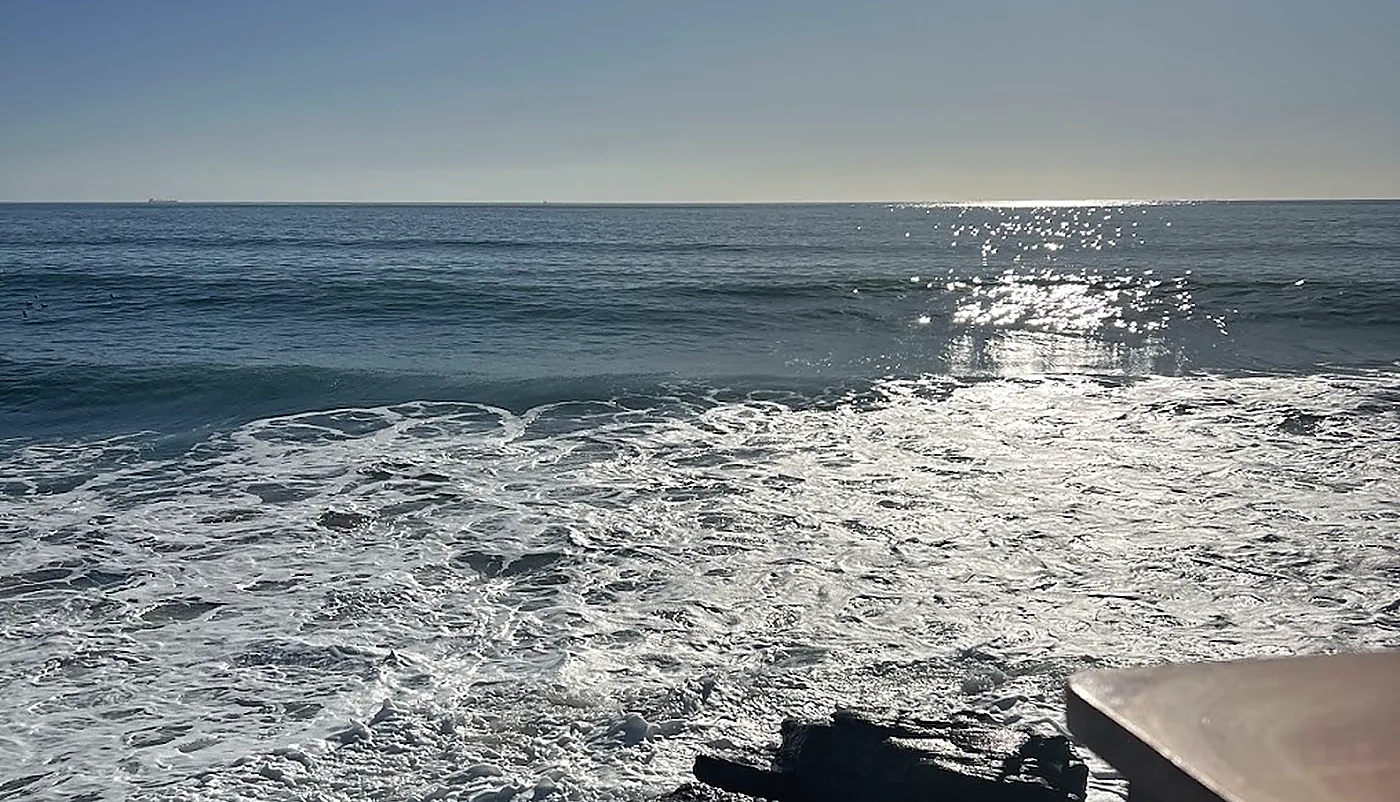
Almost everybody asking this question is on the coast for the waves and wants two or three days of desert on the end of it. That changes the answer.
Start from the coast, not from Marrakech
Every distance you will read for these dunes is measured from Marrakech, because that is where the tour industry sells from. If you are surfing Taghazout, Tamraght or Imsouane you are already three and a half hours south-west of that starting line, and the ranking changes.
From the coast, Erg Chebbi is a long day of driving each way, which is why the trips that run from Agadir are three days minimum and usually finish in Marrakech rather than doubling back. Agafay is forty minutes from Marrakech and therefore barely closer to you than Chebbi is, because either way you have to reach Marrakech first.
So the question for a surfer is not which erg is best. It is how many days you are willing to spend off the water. Answer that and the rest of this page sorts itself out.
Erg Chebbi, near Merzouga
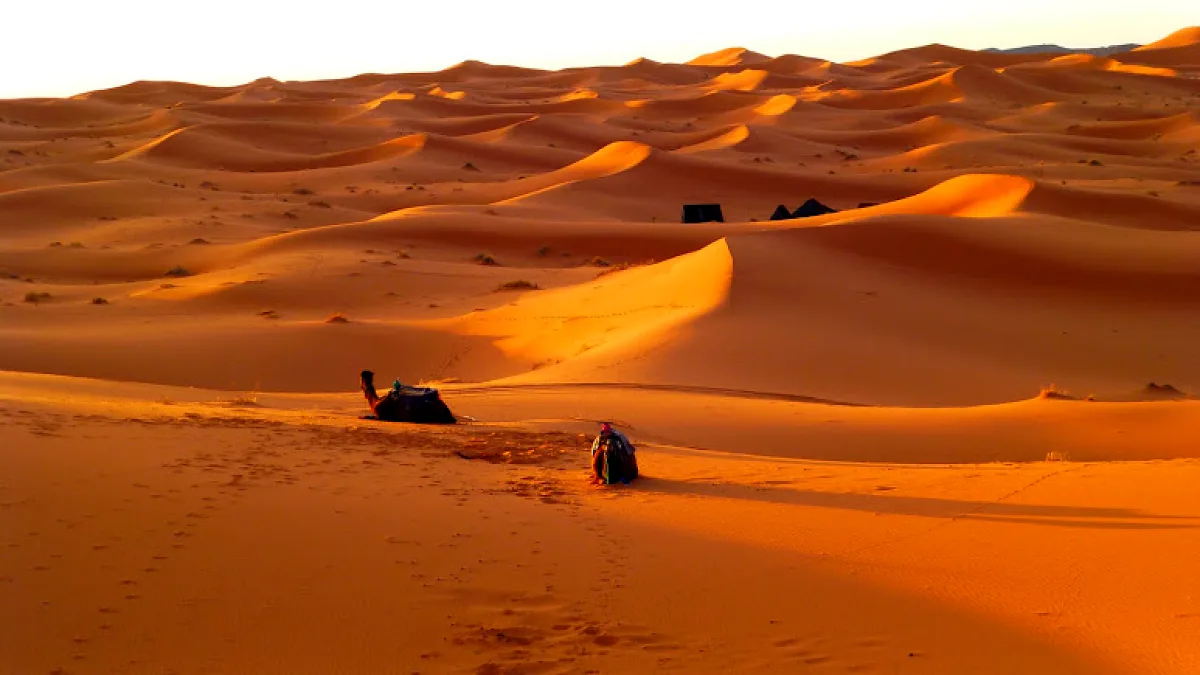
The postcard. A dune sea with crests reaching around 150 metres, deep orange in the late light, roughly eight to nine hours from Marrakech. Camps sit within the dunes and access is straightforward by camel or 4x4.
The trade-off is distance and popularity. The camps nearest the road cluster together, so a cheap trip can put you within sight of several others. Ask how far into the erg your camp actually sits.
Erg Chigaga
Larger, emptier and considerably harder to reach — nine to ten hours plus a genuine off-road transfer. What you buy is silence and the absence of other groups.
It costs more and takes longer. For a one-week trip it is usually too much; for a dedicated desert trip it is the better erg.
Zagora
Six to seven hours from Marrakech, with low dunes and stony desert. It exists because it fits into a two-day tour. It is frequently advertised using photographs of Erg Chebbi, which is where a lot of disappointment originates.
Agafay
Forty minutes from Marrakech, rocky and lunar rather than sandy. Genuinely striking at dusk and a sensible option on a short trip with no time for a long drive. It has no dunes, and no honest operator will pretend otherwise.
Coastal dunes near Agadir
Small dune fields where sand meets the Atlantic, sometimes marketed as "little Sahara". A lovely sunset sandboarding afternoon straight from a surf camp, and not the Sahara in any meaningful sense.
How to avoid the mistake
Get the place name in writing before you pay, along with how far the camp is from the nearest road. Both are reasonable questions and any decent operator answers them immediately.
How dune fields form, and why it matters to your booking
An erg is a sand sea, and it exists where wind has spent millennia moving sand into one basin and had nowhere to move it on to. Erg Chebbi sits in a depression that traps sand blown from a vast catchment, which is why its dunes reach around 150 metres while the surrounding country is flat stony hammada.
Most of the Sahara is not dunes at all. It is hammada — dark, flat, gravel-strewn plain — and reg, coarse sand and pebble. That is why "we drove into the Sahara" and "we stayed in the dunes" are entirely different sentences, and why a tour can be technically honest and still leave you disappointed.
It also explains the drive. You cannot have a large erg near Marrakech because the geography does not put one there. Distance is not an operator being awkward; it is where the sand is.
The question that settles it
How many nights do you have, and is a photograph of tall orange dunes the thing you came for?
Six or more nights and yes: Erg Chebbi. Eight or more nights, a bigger budget and a preference for silence over convenience: Erg Chigaga. Four or five nights: Agafay, and enjoy it as the rocky moonscape it is rather than resenting it for not being sand. Already on the coast with an afternoon spare: the Timlalin dunes north of Agadir, where sand meets the Atlantic — genuinely striking and genuinely not the Sahara.
Camp position matters more than camp tier
Two camps at the same price can sit two kilometres apart and deliver completely different nights. A camp near the access road hears vehicles, sees the lights of other camps and has neighbours within earshot. A camp deeper into the erg has none of that.
Ask how far the camp is from the nearest road and how many other camps are within sight. Those two questions predict your experience better than the number of stars in the description or the presence of an en-suite.
The trade is access. Deeper camps mean a longer camel or 4x4 transfer, which is fine unless somebody in your group has mobility issues.
Seasonal differences between the ergs
Erg Chebbi is more sheltered and more developed, so it functions year-round with the obvious caveat that July and August are punishing. Erg Chigaga is more exposed and sandstorms in spring can genuinely affect a visit.
Winter nights at both approach freezing. Chigaga, being more remote, generally means fewer heating options and thinner infrastructure, so December and January there are for people who genuinely like being cold in exchange for silence.
Getting to each one, in practical terms
Erg Chebbi is reached on sealed road all the way to Merzouga or Hassi Labied, then a short transfer by camel or 4x4 into the dunes. Any standard vehicle gets you to the edge. That accessibility is why most tours go there.
Erg Chigaga requires a genuine off-road leg of roughly two hours from M'Hamid in a 4x4. It is not optional and it is not comfortable. In exchange you arrive somewhere with almost nobody else in it.
Zagora is straightforward road access with a short camel ride. Agafay is forty minutes of tarmac from Marrakech. Timlalin is a coastal road drive from Agadir with a short track at the end.
Match the access to the group. A 4x4 desert crossing is a poor idea for anyone with back problems or severe motion sickness, and Chigaga is the wrong erg for them.
What the landscape actually looks like at each
Erg Chebbi is a compact, dramatic dune field roughly 22 km long and 5 km wide, rising abruptly from flat plain. The contrast is the point — you go from stony nothing to 150-metre orange dunes in a matter of metres.
Erg Chigaga is far larger and lower, spread over roughly 40 km, with dunes reaching around 60 to 90 metres. It feels more like a sea and less like a wall.
Zagora is scattered low dunes among stony desert. Agafay is grey-brown rock and dry riverbeds with the Atlas behind it, genuinely beautiful at dusk and entirely sand-free.
Timlalin is coastal dune with an ocean cliff at its edge, which is a landscape none of the inland ergs can offer.
Combining more than one
On a two-week trip you can reasonably do Timlalin as an afternoon from the coast and Erg Chebbi as a multi-day trip, and the contrast between them is genuinely interesting rather than repetitive.
Combining Chebbi and Chigaga in one trip is possible but rarely worth it. They are roughly 400 km apart across the south, and the second erg does not feel new enough to justify the drive for most people.
Agafay pairs naturally with a Marrakech city stay rather than with another desert. Treat it as an evening excursion, not as a Sahara substitute.
The one-line answer
Six nights or more and you want the postcard dunes: Erg Chebbi. Eight nights, more budget and a preference for silence: Erg Chigaga. Four or five nights: Agafay, understood as rocky desert rather than sand. An afternoon spare on the coast: Timlalin.
Whichever you choose, get the place name written into your booking. "Desert trip" is not a specification, and the gap between what people imagine and what they get is the single largest source of disappointment in Moroccan tourism.
Ask two follow-up questions and you will avoid almost all of it. Which erg, and how far is the camp from the nearest road? Any honest operator answers both immediately, often with photographs of their actual camp rather than stock imagery.
The deserts are all worth seeing. They are simply not interchangeable, and nobody benefits from pretending otherwise.