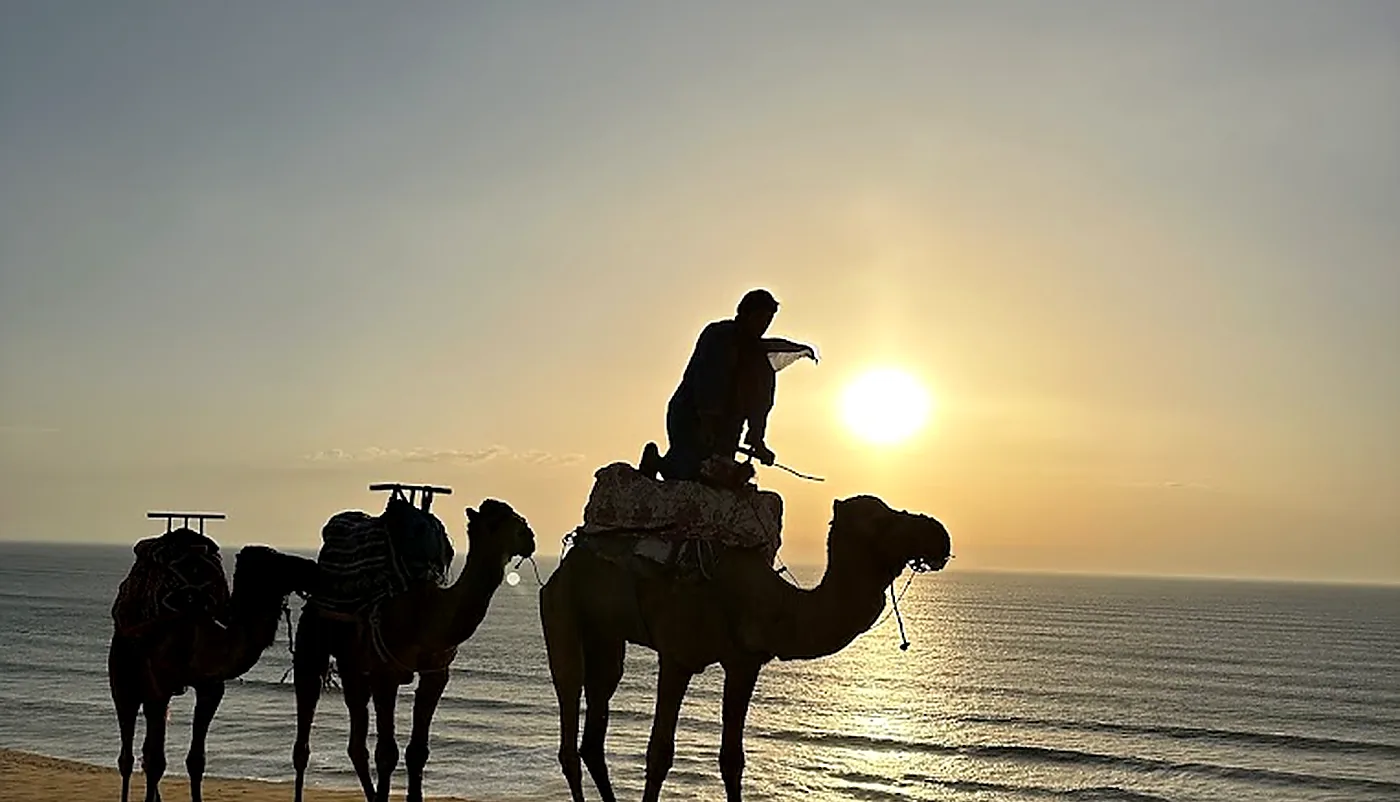
The drive inland from the surf villages is not a transfer. Done properly it is half the reason to go.
Joining the route from Taghazout or Agadir
This route is normally described from Marrakech, because that is where most of it is sold. From a surf camp on the coast there are two ways onto it. The northern one runs Agadir to Marrakech in about three and a half hours and picks the road up at the pass. The southern one runs inland through Taroudant and Ouarzazate and skips Marrakech altogether.
The southern line is the better drive and the one most surf-and-desert trips take, because it does not double back on itself. It is also why those trips finish in Marrakech and fly you home from there instead of returning you to the beach: the return leg costs a whole extra day of the week you came to surf.
If your flight is in and out of Agadir, budget that return day honestly. Three days on this route and back to the coast is tight. Four is comfortable.
Tizi n'Tichka, the pass
The road climbs to 2,260 metres through argan and walnut terraces, switchback after switchback, with the High Atlas opening up behind you. It is spectacular and it is relentless — take motion sickness tablets before you set off and sit as far forward as you can.
The pass has been substantially improved in recent years, which has shortened the journey without reducing the number of bends.
Aït Ben Haddou
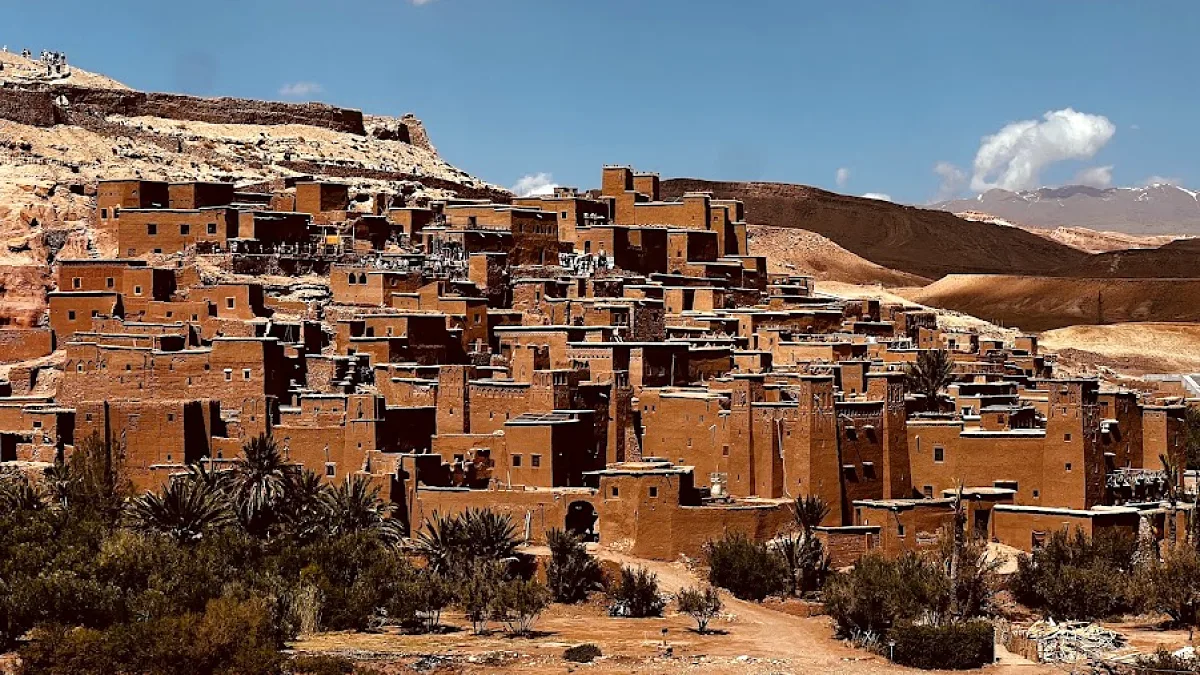
A fortified earthen village above the Ounila river, a UNESCO World Heritage Site, and instantly recognisable from a long list of films. It is built of rammed earth and still partly inhabited.
Walk up through the ksar to the granary at the top. The view back down over the tiered houses is the photograph everyone comes for, and it takes about forty minutes each way at a reasonable pace.
Ouarzazate
Morocco's film capital and the practical overnight stop. Atlas Studios is worth an hour if you like standing on old film sets and entirely skippable if you would rather find a café. Tickets are almost always separate from tour prices.
The Valley of a Thousand Kasbahs
The road east follows a chain of palm oases and mud-brick settlements. It is the least famous stretch of the journey and one of the most consistently beautiful.
Todra Gorge at Tinghir
A dense palm oasis in a narrow valley, then gorge walls rising several hundred metres either side of a road barely wide enough for two vehicles. The best leg-stretch of the whole route and a genuine break in six hours of driving.
The last stretch
From Tinghir the landscape empties out into stony hammada — flat, dark and apparently endless. Then, quite suddenly, the dunes appear on the horizon like a wall. It is one of the more dramatic arrivals in travel.
The honest numbers
Marrakech to Aït Ben Haddou is about 190 km and four hours. Ouarzazate to Tinghir, 170 km and two and a half hours. Tinghir to Merzouga, 260 km and three and a half hours. The return leg direct to Marrakech is 560 km and eight hours.
Any trip that promises all of this in less time is either skipping stops or driving in a way you will not enjoy.
Where the money and the time actually go
Marrakech to Aït Ben Haddou is 190 km and takes four hours, because the Tichka pass is 60 km of switchbacks that no vehicle crosses quickly. Aït Ben Haddou to Ouarzazate is 30 km and half an hour. Ouarzazate to Tinghir is 170 km and two and a half hours on good, straight road. Tinghir to Merzouga is 260 km and three and a half hours.
That is roughly ten and a half hours of driving to reach the dunes, which is why nobody sensible does it in one day. Split across two, with real stops, it is a pleasure. Compressed into one, it is an endurance event that arrives after dark and misses everything worth seeing.
The return leg direct to Marrakech is 560 km and eight hours, and there is no way to make it shorter.
The stops most tours skip
Telouet, off the Tichka on the old caravan road, has a kasbah of the Glaoui family with interiors of painted cedar and zellij that are startling given how ruined the exterior looks. It costs an hour and almost no group tour includes it.
The Ounila valley road between Telouet and Aït Ben Haddou is unpaved in sections and one of the most beautiful drives in the country.
Skoura, east of Ouarzazate, is a working palm oasis with kasbahs still lived in rather than restored for visitors. The Valley of Roses north of it is worth an hour in April and May when the damask roses are harvested.
If your itinerary allows a choice, ask about these. They are the difference between a route and a tour.
Practicalities of a long drive day
Sit in the front if you get motion sick, take tablets before departure rather than at the first symptom, and keep the window cracked. The Tichka is the worst section by a wide margin.
Petrol stations are frequent to Ouarzazate and then sparse. Use the toilet when you stop, not when you need to.
Carry cash from Marrakech or Ouarzazate. ATMs exist in Tinghir and Rissani but do not always work, and lunch stops on the road are cash-only.
Bring your own snacks and water. Roadside stops are geared to tour groups and priced accordingly.
Doing it independently versus on a tour
Hiring a car for the round trip costs roughly €200 to €300 for four days plus fuel, which for two people is competitive with a tour and for four people is cheaper. Roads are good and signage is adequate.
What you lose is the desert camp arrangement, the local relationships that get you tea with a nomad family rather than a staged visit, and somebody else driving the Tichka. What you gain is stopping wherever you like for as long as you like.
If you have driven in Morocco before, self-driving this route is genuinely rewarding. If you have not, the tour is the better first version.
The route in reverse, and why it sometimes suits better
Everything on this road works equally well east to west. Coming from Fes or from the coast and finishing in Marrakech means you arrive in the city at the end with the desert behind you, which many people prefer to starting in the chaos of the medina.
It also puts the Tichka pass on your final day rather than your first, which matters if you are prone to motion sickness and would rather not begin a trip that way.
The practical constraint is flights. Build the direction around which airport you fly out of, not the other way round.
Driving it yourself: what to know
Roads are generally good and well signed in Arabic and French. The Tichka is fully sealed and much improved in recent years, though it remains slow.
Police checkpoints are frequent and routine. Slow down, be polite, have your documents ready. Speed limits are enforced with radar and fines are payable on the spot.
Fuel is cheaper than in Europe and stations are frequent as far as Ouarzazate, then sparse. Fill up before long empty stretches rather than at the last opportunity.
Avoid driving after dark outside towns. Unlit vehicles, animals on the road and pedestrians make night driving in rural Morocco genuinely risky.
Book a 4x4 only if you are going beyond sealed roads. A normal car handles this entire route.
What the drive teaches you about the country
This road crosses three distinct Moroccos in two days. The High Atlas, where villages are built into slopes and agriculture is terraced and vertical. The pre-Saharan oases, where every settlement exists because of a river and the palm groves are irrigated by systems centuries old. And the hammada, where almost nothing lives and the settlements are trading posts rather than farms.
Watching the architecture change is the most legible part. Stone and timber in the mountains, then rammed earth in the valleys, then low mud-brick and palm in the south. Each is a response to what the land provides and what the climate demands.
It is the single best way to understand why Morocco feels like several countries, and it is why the drive is worth doing slowly.
Planning your version of it
Decide three things and the rest follows. Which direction — east from Marrakech, or west towards it, driven by your flights. How many days — three is the minimum that works and four is the version that gives you a whole day in the desert. And whether you are driving or being driven.
Then protect the stops. The temptation on a compressed schedule is to cut Todra or skip Aït Ben Haddou to save an hour, and both are the reason to take this route rather than flying. A trip that arrives at the dunes having seen nothing on the way is just a long drive with a nice ending.
Take the numbers seriously. Ten and a half hours out, eight hours back. That is the shape of the trip and no operator can change it. Anyone promising materially less is either skipping stops or driving in a way you will not enjoy.
Done properly, this is one of the great road journeys — three distinct landscapes, two mountain crossings and an arrival that genuinely startles people. Give it the days it needs.